

Rev. William Cook
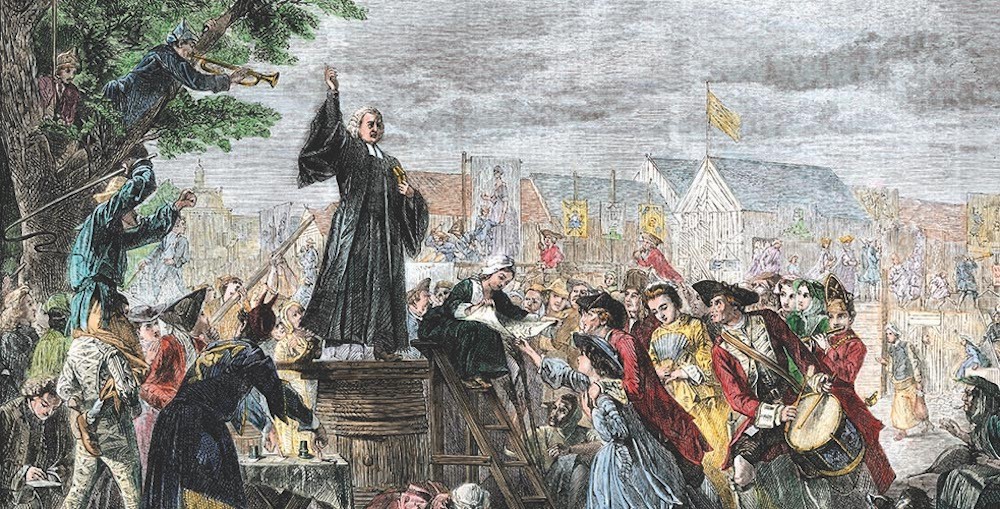
In the year 2020, one might wonder what influences inspired lawyer, statesman and Founding Father, Patrick Henry to prefer Liberty over life itself, and the means by which the “Lion of Liberty” acquired the powerful oratory that riveted the attention of Virginia’s Burgesses on his March 23, 1775 speech, which culminated in the impassioned argument, that inspired that distinguished body to adopt the resolution of the gentleman from Henry County, proposing that Virginia counties raise militiamen “to secure our inestimable rights and liberties, from those further violations with which they are threatened.”
Is life so dear, or peace so sweet, as to be purchased at the price of chains and slavery? Forbid it, Almighty God! I know not what course others may take; but as for me, give me liberty or give me death!
In 1743 Rev. William Robinson, an eminent Presbyterian minister, was sent by the Presbytery of Newcastle, as an evangelist to visit the churches in Virginia. He preached to the Dissenters [sic][i] [ii] in Hanover,[iii] and on leaving they expressed their gratitude by presenting him with a considerable sum of money. This he declined, but when he found that they had put it into his saddle-bags, he consented to keep it, if he were allowed to use it in educating a young man to be sent to them as a minister. The young man he selected was Samuel Davies. He was educated at the famous classical school of Samuel Blair at Fogg’s Manor, in Pennsylvania, and came to Hanover in 1747, after first obtaining from the Governor and Council the benefit of the toleration act, by which he was permitted to exercise his ministry unmolested. He continued to preach in Hanover and the surrounding counties, until he was called to the presidency of Princeton in 1759. This ministry of twelve years was only interrupted by a mission to England in [sic] behalf of an endowment for the college, which was entered upon in the fall of 1753, and lasted fifteen months. So successful was he in his labors in the ministry, that he is justly regarded as the father of the Presbyterian church in Virginia; and his contemporaries declared that he was the prince of American preachers, and second only as a pulpit orator to the great Whitefield. In person he was tall, well proportioned, erect, and comely; his carriage easy, graceful, and dignified; his dress neat and tasteful, and his manners polished. A distinguished Virginian well expressed the impression his appearance made, who, seeing him walk through a courtyard, remarked that he looked like the embassador [sic] of some great king. He was endowed with a voice strong, clear, and musical, a memory from which nothing seemed to escape, a powerful yet delicate imagination, a perfect command of strong, ornate, and perspicuous diction, and an animation in delivery which lighted up his features, pervaded every look, gesture, and movement, and seemed to blend the simplicity of nature with the highest culture of art. Indeed, his manner of delivery as to pronunciation, gesture, and modulation of voice was a perfect model of the most moving and striking oratory, while the sublimity and elegance, simplicity, and perspicuity of his discourses, rendered his sermons not only models for all who heard them, but for posterity as well, for whom, happily, many of them have been preserved. Whenever this august and venerable person ascended the sacred desk, he seized the attention and commanded all the various passions of his audience and imparted to the discourse a solemnity which could never be forgotten. A true patriot, he employed his great gifts in cheering up his countrymen after the depressing defeat of Braddock in 1755, and the first volunteer company raised in Virginia, after that crushing disaster, was from his congregations, the result of a patriotic discourse delivered July 20, 1755. Before this company, commanded by Captain Overton, he preached August 17, 1755, and in appealing to the martial spirit of his hearers he made prophetic mention of the young officer who had saved the command of Braddock from annihilation. He said: As a remarkable instance of this, I may point out to the public, that heroic youth, Colonel Washington, whom I cannot but hope Providence has hitherto preserved in so signal a manner for some important service to his country.
An anecdote is related of him which shows his fearlessness as a preacher. It is said that while he was in London King George II., attracted by his reputation, attended one of his services. He was so pleased that he expressed himself to those sitting near him, to the great interruption of the service. Finally, Mr. Davies fixed his eye upon him, and said, with great solemnity: When the lion roareth, the beasts of the forest tremble; when the Lord speaketh, let the kings of the earth keep silence. The King shrank back in his seat and remained quiet during the remainder of the discourse, and next day sent for Mr. Davies and gave him fifty guineas for the college, observing at the same time to his courtiers, He is an honest man! An honest man!
It was under the influence of such a man that Patrick Henry came at the impressionable age of twelve. One of the places at which Mr. Davies Preached was known as the Fork Church, and Mrs. John Henry, who became a member of his church, attended regularly. She was in the habit of riding in a double gig, taking with her young Patrick, who, from the first, showed a high appreciation of the preacher. Returning from church she would make him give the text and a recapitulation of the discourse. She could have done her son no greater service. His sympathetic genius was not only aroused by the eloquence of the preacher, who, he ever declared, was the greatest orator he ever heard, but he learned from him that robust system of theology which is known as Calvinism, and which has furnished to the world so many of her great characters—a system of which Froude writes: It has been able to inspire and sustain the bravest efforts ever made by man, to break the yoke of unjust authority, … has borne ever an inflexible front to illusion and mendacity, and has preferred rather to be ground to powder, like flint, than to bend before violence, or melt under enervating temptation.[iv]
[i] One who separates from the service and worship of any established church. The word is in England particularly applied to those who separate from, or who do not unite with, the church of England.
[ii] “dissenter” [sic]. webstersdictionary1828.com. 1828. https://webstersdictionary1828.com (11 September 11 2022).
[iii] Hanover is an unincorporated community and census-designated place (CDP) in Hanover County, Virginia, United States. Hanover is the county seat and is located at the junction of US Route 301 and State Route 54 south of the Pamunkey River. While historically known as Hanover Courthouse, the US Geological Survey, Census Bureau, Postal Service and residents refer to it as “Hanover.” The population as of the 2010 census was 252. Hanover County Courthouse, designated a National Historic Landmark, is the county’s most notable structure. The attorney, and eventual statesman and Founding Father, Patrick Henry practiced law at the Courthouse and argued the Parson’s Cause. The Courthouse lies within the Hanover County Courthouse Historic District, which includes the Hanover Tavern. Rebuilt in 1791 on the site of a Revolutionary-era tavern, the tavern was adapted in 1953 as the Barksdale Theatre, the nation’s first dinner theatre. Barksdale was Virginia’s first performing arts organization to seat integrated audiences. The Hanover County Courthouse is an operating courthouse. Located along US Route 301, it is across the green from the Hanover Tavern. The courthouse is the third oldest courthouse still in use in the United States. Some local historians cited the courthouse as built in 1735, but the state historical society notes it was built between 1737 and 1742.
[iv] Address to the students at St. Andrews, March 17, 1781.